Views: 0 Author: Site Editor Publish Time: 2026-06-29 Origin: Site
The industrial landscape of heavy manufacturing requires robust, reliable, and highly engineered components to maintain continuous operations under extreme conditions. Among the most demanding environments are the thermal processing units utilized across various sectors, particularly within the rapidly expanding infrastructure and construction materials sectors. In this context, the utilization of high-quality V Type Refractory Anchors has become a fundamental requirement for ensuring the structural integrity and longevity of thermal linings. As production demands increase, the necessity for specialized anchoring systems that can withstand severe mechanical and thermal stresses is paramount. Cement manufacturing facilities, in particular, face unique challenges related to intense heat, continuous vibration, and aggressive chemical atmospheres. To address these complex operational hurdles, facility engineers and maintenance professionals rely heavily on advanced refractory solutions. The deployment of a properly specified V Type Refractory Anchor is critical for securing castable materials and preventing catastrophic lining failures that could lead to costly downtime and safety hazards.
n recent years, the demand for high-performance refractory anchoring systems has been increasing significantly in emerging industrial markets such as Mexico. Cement plants in Mexico are undergoing continuous modernization and capacity expansion, which requires more reliable refractory lining support systems to ensure operational stability under high-temperature conditions.
High-quality V Type Refractory Anchors utilized for securing castable linings in high-temperature industrial applications.
The cement production process is inherently rigorous, involving the transformation of raw materials into clinker at temperatures that can exceed standard operational thresholds of conventional materials. Within the rotary kilns, preheaters, and clinker coolers, the internal refractory lining is subjected to continuous thermal cycling as the equipment heats up and cools down during different phases of operation or maintenance shutdowns. Furthermore, the massive mechanical rotation and the movement of heavy raw materials generate significant vibration. Without a secure anchoring mechanism, the monolithic refractory castables would quickly detach from the steel shell, leading to severe equipment damage. The Leader Steel V Type Refractory Anchor is specifically designed to mitigate these risks. By providing a reliable mechanical bond between the steel casing and the refractory material, these anchors ensure that the lining remains intact, thereby optimizing the thermal efficiency of the equipment and protecting the structural steel from direct exposure to extreme heat and corrosive gases.
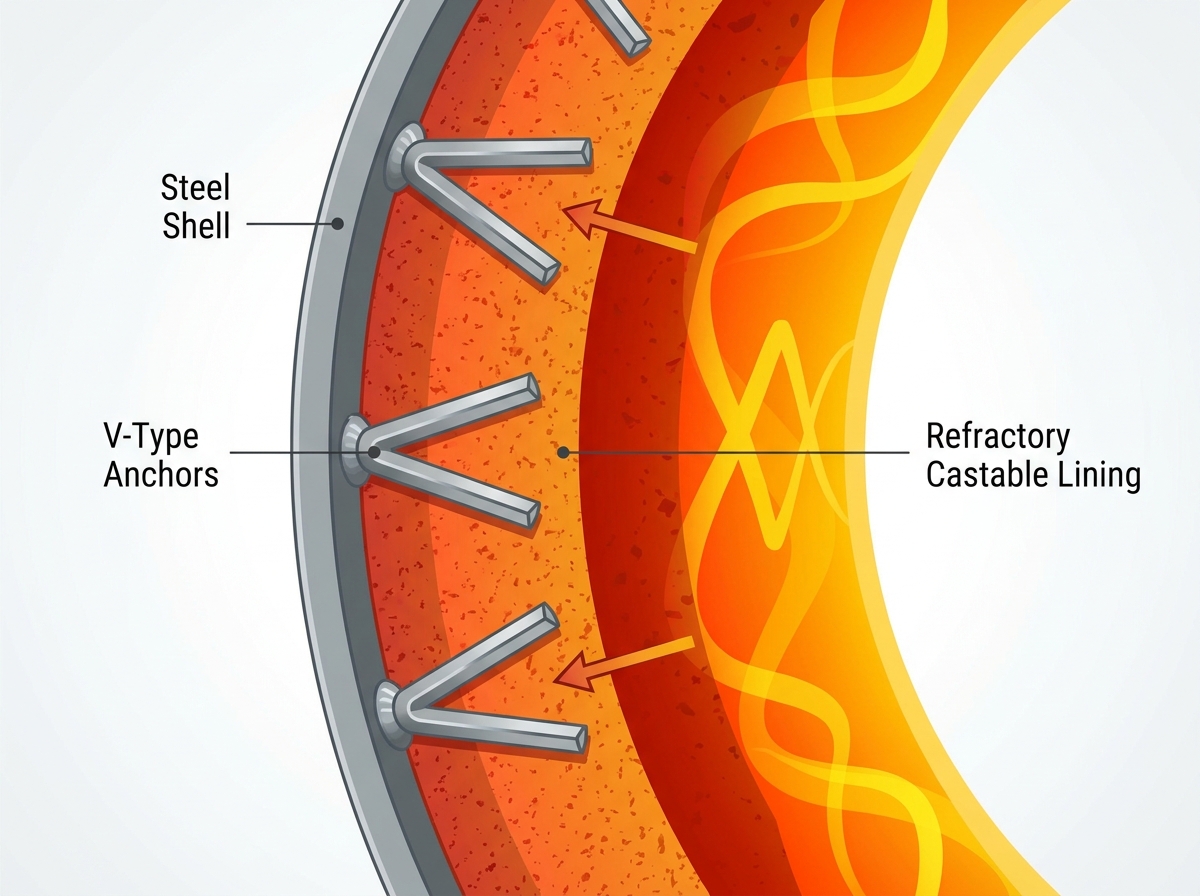
Understanding the mechanical and thermal dynamics of industrial furnaces and kilns is essential for appreciating the design and function of specialized anchoring systems. The primary purpose of any refractory anchor is to hold the refractory lining against the wall or roof of the thermal equipment, preventing it from falling or buckling under its own weight or due to operational stresses. The V-shaped structure provides stable retention for castables during thermal cycling and vibration. This specific geometric configuration is not arbitrary; it is the result of extensive engineering analysis aimed at maximizing the surface area contact between the steel anchor and the surrounding monolithic material. When the castable refractory is poured or gunned into place, it flows around the V-shaped prongs, creating a highly secure interlocking matrix once the material cures and hardens.
Thermal cycling is one of the most destructive forces acting upon industrial refractory linings. As temperatures rise, both the steel shell of the equipment and the refractory lining expand. However, they expand at different rates due to their distinct coefficients of thermal expansion. When the equipment cools, they contract. This continuous expansion and contraction create immense shear stresses at the interface between the lining and the shell. The V-shaped structure of the V Type Refractory Anchors is uniquely capable of absorbing and distributing these stresses. The angled arms of the V pattern allow for a certain degree of flexibility and movement, accommodating the differential expansion without snapping or causing the surrounding castable to crack excessively. This stable retention is absolutely vital in environments where temperature fluctuations are a regular part of the operational cycle.
In addition to thermal stresses, industrial equipment such as cement rotary kilns, massive industrial boilers, and power generation equipment generate substantial mechanical vibration. This vibration can cause unanchored or poorly anchored refractory materials to slowly loosen, crumble, and eventually fail. The Leader Steel V Type Refractory Anchor addresses this challenge through its robust design. The V-shaped structure provides stable retention for castables during thermal cycling and vibration, ensuring that the monolithic lining remains firmly attached to the substrate even under continuous mechanical shaking. The geometry of the anchor effectively locks the castable in place, preventing the microscopic movements that lead to material degradation and structural fatigue over time. This resistance to vibration is a critical factor in extending the service life of the refractory lining and reducing the frequency of required maintenance interventions.
The performance of any refractory anchoring system is fundamentally dependent on the materials from which it is constructed. Because these anchors are embedded within the refractory lining, they are exposed to extreme temperatures, oxidizing or reducing atmospheres, and potentially corrosive chemical compounds present in the fuel or raw materials. Therefore, material selection is dependent on operating temperature, thermal cycling, atmosphere, and refractory thickness. The anchors must possess exceptional high-temperature strength, oxidation resistance, and metallurgical stability to function effectively over long periods.
For applications involving moderate to high temperatures, standard austenitic stainless steels are often employed. The verified materials for these anchors include 304 and 321 stainless steel. Grade 304 is a versatile and widely used stainless steel that offers excellent corrosion resistance and good high-temperature strength, making it suitable for less aggressive thermal zones within industrial equipment. However, in environments where temperatures are higher and the risk of carbide precipitation during welding or operation is a concern, Grade 321 is frequently selected. Grade 321 is stabilized with the addition of titanium, which prevents the formation of chromium carbides at the grain boundaries, thereby maintaining the material's corrosion resistance and structural integrity even after prolonged exposure to elevated temperatures. These materials are fabricated into the V Type / Round Pattern shape to provide reliable anchoring in their respective temperature ranges.
In the most extreme thermal environments, such as the burning zones of cement kilns, petrochemical heaters, and steel plant thermal units, standard stainless steels are insufficient. For these demanding applications, the anchors are manufactured from highly alloyed materials. The verified materials include 310S and 2520 stainless steel and heat-resistant alloys. Grade 310S is a highly alloyed austenitic stainless steel designed specifically for high-temperature service. Its high chromium and nickel content provides exceptional resistance to oxidation and sulfidation, as well as excellent strength at temperatures well above those that would destroy lower-grade alloys. The 2520 alloy (often synonymous with or closely related to the 310 series depending on regional naming conventions) similarly offers superior performance in severe environments. By utilizing these advanced heat-resistant alloys, the anchors can withstand the brutal conditions found in incinerators, furnaces, and high-temperature ducts without melting, heavily oxidizing, or losing their mechanical grip on the refractory castable.
Industrial thermal equipment is not uniform; it varies wildly in size, shape, operating parameters, and lining design. Consequently, a one-size-fits-all approach to refractory anchoring is highly ineffective and potentially dangerous. To accommodate the vast array of industrial applications, these anchoring systems must be highly adaptable. The manufacturer provides customizable diameter, length, and shape to fit specific lining thicknesses and shell designs. This flexibility ensures that engineers can specify the exact anchor dimensions required to optimize the performance of their specific refractory system.
The thickness of a refractory lining is determined by the thermal insulation requirements and the anticipated wear rate of the specific application. A lining might be only a few inches thick in a low-temperature duct, or it could be over a foot thick in a high-temperature furnace. The anchors must be sized accordingly. If an anchor is too short, it will not reach deep enough into the castable to provide adequate holding power, leading to surface spalling and lining failure. If an anchor is too long, it may reach too close to the hot face of the refractory, exposing the metal tip to temperatures that exceed its melting point or causing rapid oxidation that destroys the anchor from the tip down. By offering customizable diameter, length, and shape, the anchors can be perfectly matched to the specific lining thicknesses and shell designs of any given project, ensuring optimal embedment depth and maximum retention strength.
The manufacturing processes used to create these anchors are designed to produce robust, high-quality components capable of surviving harsh industrial conditions. The verified fabrication methods include wire formed, welded, or fabricated to drawing. Wire forming is a highly efficient process for producing large quantities of standard V Type / Round Pattern anchors. High-strength alloy wire is precisely bent and shaped into the required V configuration. For more complex designs or heavier duty applications, welding is employed. Welded anchors can incorporate different base plates or specialized attachment points to suit specific installation requirements. Furthermore, the ability to be fabricated to drawing means that custom-engineered anchoring solutions can be produced to meet the unique challenges of highly specialized or proprietary thermal equipment designs. This versatility in fabrication ensures that whether a facility requires thousands of standard anchors or a small batch of highly customized components, the precise specifications can be met.
The necessity for reliable refractory anchoring spans numerous sectors of heavy industry. Any process that involves the containment, transfer, or utilization of extreme heat relies on refractory linings, and those linings rely on anchors. The verified use cases for these V-shaped anchors are extensive, encompassing a wide range of critical industrial infrastructure.
Cement plants represent one of the most demanding environments for refractory materials. The production of cement clinker involves heating raw materials to approximately 1450 degrees Celsius in massive rotary kilns. The entire system, from the preheater tower down to the clinker cooler, requires extensive refractory lining. These anchors are explicitly designed for securing refractory castables and linings in cement process equipment. In the preheater cyclones, where hot gases are used to heat the incoming raw meal, the linings are subjected to abrasive dust and high temperatures. In the clinker cooler, the glowing hot clinker is rapidly cooled by forced air, creating severe thermal shock conditions. Throughout all these zones, the V-shaped structure provides stable retention for castables during thermal cycling and vibration, ensuring the continuous and safe operation of the cement manufacturing process.
Beyond cement production, these anchors are vital components in various other types of thermal processing units. They are used extensively for securing refractory castables and linings in furnaces, kilns, and boilers. Industrial furnaces, whether used for heat treating metals, melting glass, or processing ceramics, require stable linings to maintain temperature uniformity and energy efficiency. Kilns used in the production of lime, alumina, and other minerals face similar challenges to cement kilns, including thermal cycling and mechanical stress. Industrial boilers, which generate steam for power generation or process heat, rely on refractory linings to protect the outer steel casing from the intense heat of the combustion chamber. In all these applications, the customizable diameter, length, and shape of the anchors allow them to be tailored to the specific lining thicknesses and shell designs of the equipment.
Waste management and emission control systems also heavily utilize refractory-lined equipment. Incinerators, which burn municipal, industrial, or hazardous waste, operate at extremely high temperatures to ensure complete combustion and the destruction of harmful compounds. The refractory linings in these units must withstand not only high heat but also severe chemical attack from the varied waste streams. High-temperature ducts, which transport hot exhaust gases from furnaces or kilns to scrubbers or stacks, also require secure refractory linings to prevent heat loss and protect the ductwork from thermal degradation. The anchors are verified for use in securing refractory castables and linings in incinerators and ducts, providing the necessary mechanical support to maintain lining integrity in these harsh, corrosive, and high-velocity environments.
The petrochemical and metallurgical industries operate some of the most extreme thermal equipment in the world. Petrochemical heaters are used to crack hydrocarbons and facilitate complex chemical reactions at high temperatures and pressures. Steel plant thermal units, including blast furnaces, basic oxygen furnaces, ladles, and tundishes, handle molten metal at temperatures exceeding 1500 degrees Celsius. The refractory linings in these applications are critical for safety and operational success. The anchors are utilized for securing refractory castables and linings in petrochemical heaters and steel plant thermal units. The availability of advanced materials like 310S, 304, 321, 2520 stainless steel and heat-resistant alloys ensures that the anchors can survive the intense heat, reducing atmospheres, and corrosive conditions typical of these heavy industrial processes.
Power plants, whether fueled by coal, biomass, or natural gas, rely on massive thermal units to generate the steam that drives their turbines. The boilers, ash hoppers, and exhaust systems of these plants are lined with refractory materials to manage the intense heat and protect the structural components. The anchors are essential for securing refractory castables and linings in power generation equipment. By preventing lining failures, these anchors help to maximize the uptime and efficiency of the power generation process, ensuring a reliable supply of electricity to the grid. The V-shaped structure provides stable retention for castables during thermal cycling and vibration, which is particularly important in power plants where equipment may be cycled on and off to meet fluctuating energy demands.
The field of refractory engineering has evolved significantly, with a growing emphasis on monolithic linings over traditional brick linings for many applications. Monolithic linings, which include castables, plastics, and ramming mixes, offer advantages in terms of installation speed, jointless construction, and the ability to conform to complex geometries. The Leader Steel V Type Refractory Anchor is specifically designed to work in tandem with these modern materials. The anchors are compatible with castable and monolithic lining systems, depending on lining design and installation method.
Castable refractories are supplied as dry powders that are mixed with water (or a special liquid binder) and then poured, pumped, or pneumatically shot (gunned) into place. As the material cures, it forms a solid, monolithic mass. The V Type / Round Pattern shape of the anchors is ideal for this type of installation. As the wet castable flows around the anchors, it completely encapsulates the metal prongs. Once the material sets, the V-shape provides a multidirectional mechanical lock, preventing the castable from pulling away from the shell. This compatibility with castable and monolithic lining systems ensures that facilities can take full advantage of the benefits of monolithic refractories without compromising on structural stability.
Even the highest quality refractory anchor will fail if it is not installed correctly or if it is subjected to conditions beyond its design parameters. Proper installation is a precise engineering discipline that requires careful planning and execution. The anchor design must match the temperature zone and lining thickness to avoid premature refractory failure. This means that engineers must conduct thorough thermal calculations to determine the exact temperature profile through the lining thickness under normal operating conditions.
Different areas within a single piece of equipment can experience vastly different temperatures. For example, the burning zone of a rotary kiln is significantly hotter than the preheating zone. Therefore, the anchors used in the burning zone must be made from high-temperature alloys like 310S or 2520, while standard 304 stainless steel might be sufficient for the cooler zones. If an anchor made from a lower-grade alloy is installed in a high-temperature zone, it will rapidly oxidize, lose its strength, and fail, causing the lining to collapse. The installation protocol dictates that the anchor design must match the temperature zone and lining thickness to avoid premature refractory failure, ensuring that the correct material is deployed in the correct location.
Premature refractory failure is a major operational headache that leads to unscheduled downtime, lost production, and expensive emergency repairs. Many of these failures can be traced back to improper anchoring. If the anchors are spaced too far apart, the castable may crack and fall out in large chunks. If the anchors are too close to the hot face, they will melt or oxidize. If the welding quality attaching the anchor to the shell is poor, the anchor will break off under stress. By adhering to the principle that the anchor design must match the temperature zone and lining thickness to avoid premature refractory failure, maintenance teams can significantly improve the reliability and lifespan of their thermal linings. The customizable diameter, length, and shape of the anchors facilitate this precise matching process.
While V Type Refractory Anchors are incredibly robust, they are not indestructible. Their performance is governed by the laws of metallurgy and thermodynamics. It is crucial for engineers and operators to understand the limitations of these components to ensure safe and reliable operation. The fundamental limitation is that material selection is dependent on operating temperature, thermal cycling, atmosphere, and refractory thickness. Ignoring any of these factors during the specification process can lead to catastrophic results.
The temperature is not the only environmental factor that affects anchor performance; the chemical composition of the atmosphere within the equipment is equally critical. Industrial processes can generate atmospheres that are highly oxidizing, reducing, carburizing, or sulfidizing. Certain alloys perform well in oxidizing environments but degrade rapidly in reducing atmospheres. For example, high-nickel alloys might be susceptible to sulfidation if the fuel used contains high levels of sulfur. Therefore, when specifying anchors for furnaces, kilns, boilers, incinerators, ducts, petrochemical heaters, cement process equipment, steel plant thermal units, and power generation equipment, the engineer must carefully evaluate the chemical environment. The fact that material selection is dependent on operating temperature, thermal cycling, atmosphere, and refractory thickness highlights the necessity of a holistic engineering approach to refractory design.
As the industrial sector in Mexico continues to modernize and expand, the demand for high-performance refractory systems will only increase. Cement plants, steel mills, and petrochemical facilities are constantly seeking ways to improve thermal efficiency, reduce maintenance costs, and extend operational campaigns. The utilization of advanced anchoring solutions is a key component of this optimization strategy. By leveraging the customizable diameter, length, and shape of these V-shaped anchors, facilities can design linings that are perfectly tailored to their specific operational profiles.
The continuous improvement of refractory materials and anchoring systems is essential for the advancement of heavy industry. The ability to securely hold castable and monolithic lining systems in place under conditions of severe thermal cycling and vibration is a testament to the sophisticated engineering behind these relatively simple-looking components. Whether fabricated via wire formed, welded, or fabricated to drawing methods, these anchors represent a critical line of defense against thermal degradation. As facilities push their equipment to higher temperatures and longer operating cycles to maximize output, the reliance on high-quality materials like 310S, 304, 321, 2520 stainless steel and heat-resistant alloys will become even more pronounced.
The V Type Refractory Anchor represents a critical, highly engineered solution for securing monolithic and castable linings across a broad spectrum of demanding industrial environments, including cement plants, steel mills, petrochemical facilities, and power generation units. By utilizing a specialized V-shaped structure, these anchors deliver exceptional stability and retention, effectively counteracting the destructive forces of severe thermal cycling and continuous mechanical vibration. The extensive customizability in diameter, length, and shape ensures precise integration with specific lining thicknesses and complex shell designs, while the availability of diverse, high-grade materials—ranging from 304 and 321 to advanced 310S and 2520 heat-resistant alloys—guarantees optimal performance tailored to specific operating temperatures and atmospheric conditions. For facility engineers and maintenance professionals focused on maximizing equipment uptime, preventing premature refractory failure, and ensuring the structural integrity of critical thermal processing units, integrating these meticulously fabricated anchors is an essential strategy for achieving long-term operational reliability and safety.
With ongoing investments in cement production capacity across Mexico, the demand for reliable refractory anchoring systems is expected to continue growing, particularly in high-temperature processing units.