Views: 0 Author: Site Editor Publish Time: 2026-06-29 Origin: Site
Industrial operations across Mexico rely heavily on robust thermal processing equipment to maintain high production standards and operational efficiency. Maintaining the structural integrity of high-temperature furnaces, rotary kilns, and power plant boilers requires meticulous engineering and the selection of premium internal components. Among the most critical elements in these complex thermal systems are the internal supports that hold the protective insulation and refractory linings securely in place. Selecting the right Refractory Anchor Materials is absolutely essential for preventing catastrophic lining failures, minimizing costly operational downtime, and ensuring the safety of facility personnel. When extreme thermal expansion and contraction occur during standard heating and cooling cycles, the internal lining must remain securely fastened to the outer structural shell to prevent collapse and heat loss.
Premium refractory anchors designed to secure furnace linings and withstand extreme thermal and mechanical stresses.
The industrial sector demands components that can survive the harshest environments imaginable. Refractory anchors serve as the vital skeleton of any high-temperature enclosure. Without these crucial fasteners, the heavy refractory concrete, castables, and brickwork would simply detach from the steel casing under the immense pull of gravity and the sheer force of thermal dynamics. Understanding the specific metallurgical properties, structural designs, and application methods of these anchors is the first step toward optimizing furnace longevity and performance. Facility managers and refractory engineers must carefully evaluate their specific operational parameters to choose the correct anchoring system for their unique thermal processing needs.
When discussing the foundational elements of high-temperature industrial equipment, the conversation inevitably turns to the specific alloys and metals used in construction. The performance of Refractory Anchor Materials dictates the overall lifespan of the furnace lining. These components, manufactured by industry leaders like Leader Steel, are engineered to provide unwavering support under the most demanding conditions. They are widely recognized in the industry under various nomenclatures, including anchor pins, anchor hooks, grip nails, insulation nails, rake nails, claw nails, boiler anchors, rotary kiln anchors, and furnace anchors. Regardless of the terminology used on the job site, their primary function remains identical: to anchor the refractory mass to the structural shell.
The selection of the appropriate metal grade is a complex decision that hinges on the maximum operating temperature of the furnace, the chemical environment within the combustion chamber, and the physical weight of the refractory lining being supported. Using an inferior steel grade in a high-heat zone will result in rapid oxidation, scaling, and eventual mechanical failure of the anchor. Conversely, over-specifying the material for a low-temperature application can lead to unnecessary project costs. Therefore, a comprehensive understanding of the available metallurgical options is required to strike the perfect balance between performance and economic efficiency.
The internal environment of a boiler or rotary kiln is incredibly hostile. The Refractory Anchor Materials must endure continuous exposure to extreme heat, often fluctuating rapidly, which induces severe thermal shock. Furthermore, these anchors are subjected to a complex array of physical forces. They are specifically designed to resist static loads from the sheer weight of the thick refractory cement or castables. In dynamic equipment like rotary kilns, the anchors must also withstand continuous mechanical rotation, which introduces alternating stress cycles that can cause metal fatigue in inferior materials.
Vibrations from surrounding heavy machinery, burners, and exhaust fans transmit directly through the furnace shell into the anchoring system. The anchors must possess the necessary tensile strength to resist tension forces pulling the lining away from the wall, as well as the resilience to withstand shear forces and bending moments caused by the differential expansion between the hot refractory lining and the cooler steel casing. If the anchors lack the precise metallurgical composition to handle these combined stresses, the refractory lining will crack, bulge, and eventually spall, exposing the vulnerable steel shell to direct flame and extreme temperatures.
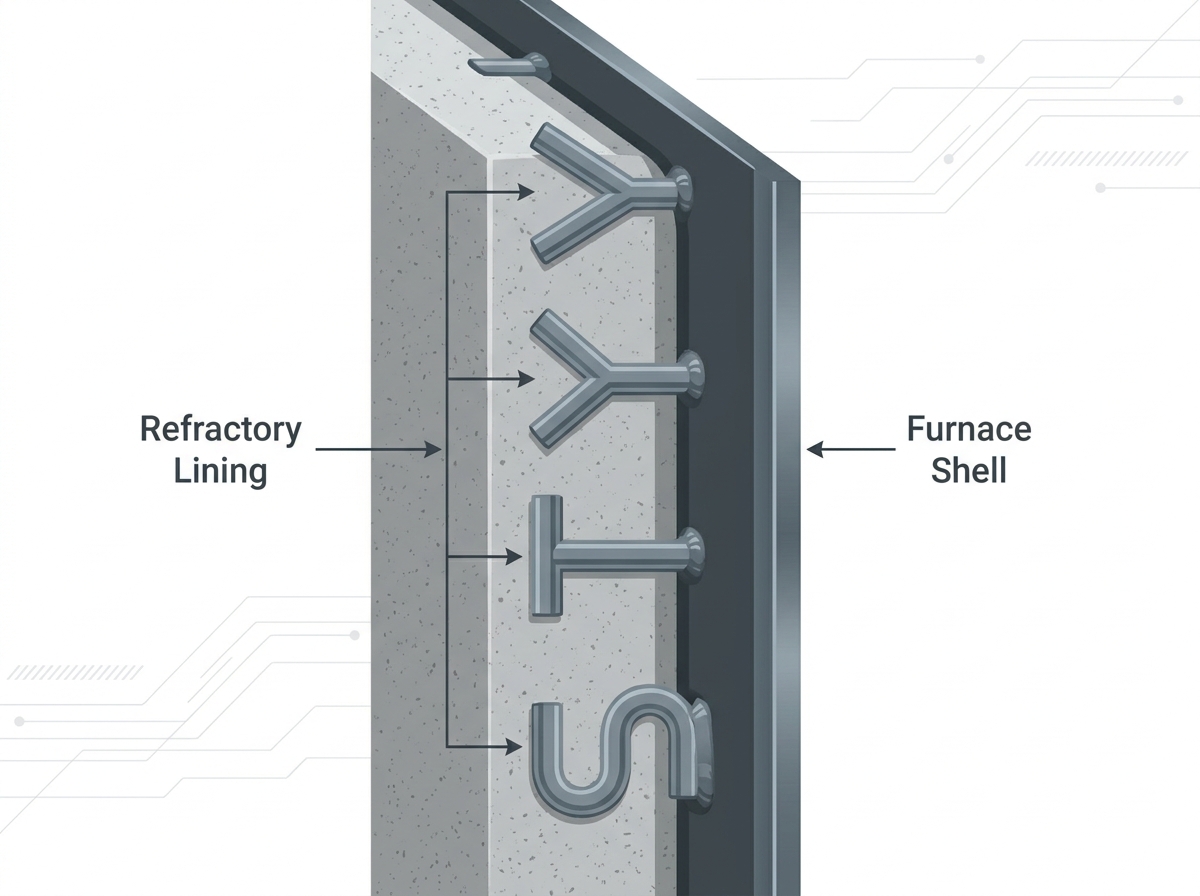
The physical shape of the refractory anchor is just as critical as its material composition. Different areas of a furnace or boiler require different anchoring strategies based on the thickness of the lining, the method of refractory application, and the specific physical forces at play in that zone. Leader Steel manufactures a versatile range of anchor profiles to accommodate these diverse engineering requirements. The most prevalent and effective designs available include the V, Y, T, and S anchor types.
V-type anchors are highly popular for their straightforward design and excellent holding power in standard castable linings. Their diverging tines provide a wide area of engagement within the refractory matrix, ensuring that the load is distributed evenly across the material. Y-type anchors offer a similar diverging profile but often feature a specialized base or stem that provides additional standoff distance from the shell, which is particularly useful when dual-layer linings (insulation plus dense refractory) are utilized.
T-type anchors are frequently employed in applications where a robust, flat-profile engagement is necessary, often used in conjunction with specific types of refractory brick or specialized block linings. S-type anchors provide a unique undulating profile that maximizes the surface area contact between the metal and the refractory cement, creating a highly tortuous path that prevents the castable from slipping or detaching under severe vibration or mechanical shock. The choice between V, Y, T, and S configurations depends entirely on the specific engineering drawings and the operational demands of the thermal equipment.
While standard V, Y, T, and S configurations meet the needs of many industrial applications, specialized thermal processing equipment often requires bespoke solutions. One of the significant advantages of sourcing high-quality anchors is the availability of custom manufacturing to meet specific requirements. Engineers can specify exact leg lengths, tine angles, wire diameters, and base configurations to perfectly match their unique refractory lining designs. This custom capability ensures that even the most complex geometric profiles within a furnace, such as burner blocks, roof transitions, and intricate flue gas ducts, can be adequately anchored and protected against premature failure.
The core of an anchor's performance lies in its metallurgical makeup. A wide spectrum of steel grades is utilized to manufacture these critical components, allowing engineers to precisely match the anchor's temperature resistance to the specific thermal zone within the equipment. The available materials encompass a comprehensive range of carbon steels, alloy steels, and high-grade stainless steels.
For lower temperature applications or areas where the anchors are embedded deeply within protective insulation layers, standard carbon and low-alloy steels are often sufficient. The available materials include Q235B, 20# steel, and 45# steel. These grades provide excellent mechanical strength and weldability at a cost-effective price point, provided they are not exposed to temperatures that would induce rapid oxidation. For slightly more demanding environments, low-alloy heat-resistant steels such as 15CrMo and 12Cr1MoV offer improved elevated-temperature strength and better resistance to creep, making them suitable for intermediate thermal zones.
When the application demands direct exposure to high temperatures or aggressive chemical atmospheres, stainless steel becomes the mandatory choice. The chromium and nickel content in these alloys forms a protective oxide layer that prevents further degradation of the metal matrix. The available stainless steel grades for these anchors include 1Cr13, 304 stainless steel, 321 stainless steel, 01 stainless steel, 2520 stainless steel, 310s stainless steel, 1Cr18Ni9Ti stainless steel, and 0Cr25Ni20 stainless steel.
Grade 304 stainless steel is a versatile and widely used material for general high-temperature applications, offering good oxidation resistance up to moderate limits. However, for the most extreme environments found in heavy industrial furnaces and boilers, superior grades like 310s stainless steel and 2520 stainless steel (which is highly similar in composition to 310s) are deployed. These high-chromium, high-nickel alloys provide exceptional resistance to oxidation and high-temperature corrosion, maintaining their structural integrity even when subjected to the intense heat of a combustion chamber. Grades like 321 and 1Cr18Ni9Ti include titanium additions to stabilize the carbon, preventing intergranular corrosion during welding and prolonged high-temperature exposure.
The practical applications for these specialized fasteners span across virtually every heavy industry operating in Mexico, from cement manufacturing and petrochemical refining to power generation and steel production. The primary use case is securing refractory linings in high-temperature industrial applications such as furnaces, kilns, and boilers. Without a reliable anchoring system, the immense thermal and mechanical stresses would quickly destroy the protective linings, leading to catastrophic equipment failure.
In the power generation sector, these anchors are critical for hanging castables in boilers and power plant boiler flues. The complex geometry of boiler tubes and flue gas ducts requires a versatile anchoring system that can hold the refractory material securely against the steel walls, protecting the structural components from the erosive and corrosive effects of high-velocity, high-temperature exhaust gases. Utilizing a premium Heat-Resistant Refractory Anchor ensures that the castable remains firmly in place, optimizing the thermal efficiency of the boiler system and preventing dangerous hot spots on the outer casing.
Similarly, in the metallurgical and glass industries, these components are essential for hanging refractory cement in furnaces. The roofs and walls of these furnaces are subjected to extreme radiant heat and chemical attack from the molten materials within. The anchors must hold the heavy refractory cement securely overhead, resisting the constant pull of gravity and the expansive forces of the heat. In the cement industry, rotary kilns rely heavily on these anchors to maintain their internal linings while constantly rotating, a dynamic environment that tests the absolute limits of the anchor's fatigue resistance and shear strength.
Beyond securing refractory linings within steel-cased equipment, these versatile anchoring systems also play a crucial role in broader industrial construction and installation projects. They are highly effective for fastening structural components, equipment, or heavy machinery to foundational structures. Industrial facilities often require robust anchoring solutions to secure massive pieces of equipment against vibration, seismic activity, and operational loads.
The engineering design of these anchors makes them fully compatible with foundational structures such as concrete, rock, or soil. Whether embedding the anchors into freshly poured concrete foundations to secure a new furnace installation or utilizing them to stabilize heavy machinery on existing rock or compacted soil bases, their high tensile strength and resistance to bending moments provide a secure and permanent connection. This broad compatibility ensures that industrial contractors have a reliable fastening solution for both the internal high-temperature zones and the external structural foundations of their heavy equipment.
The success of any refractory installation depends entirely on the anchor's ability to manage stress. Thermal stress is perhaps the most destructive force at play. As the furnace heats up, the steel shell and the refractory lining expand at different rates. This differential expansion creates massive shear forces at the interface where the anchor connects the two materials. If the anchor is too rigid or made from a brittle material, it will snap. If it is too soft, it will deform and lose its grip on the castable. The specific alloys used, such as 310s stainless steel or 15CrMo, are chosen specifically for their ability to maintain their yield strength at elevated temperatures while providing enough ductility to absorb these thermal movements without fracturing.
Static loads are another constant challenge. Refractory concrete is incredibly dense and heavy. In a large industrial boiler or furnace roof, the anchors are responsible for suspending tons of material overhead. The V, Y, T, and S designs are engineered to maximize the load-bearing capacity by distributing this weight across a larger volume of the refractory matrix. This prevents localized stress concentrations that could cause the castable to crack and pull away from the anchor tines.
Mechanical rotation and vibrations introduce dynamic stresses that can quickly lead to metal fatigue. In a rotary kiln, the refractory lining and its anchors are constantly lifted and dropped as the massive cylinder turns. This continuous cycling requires anchors with exceptional fatigue resistance. The high-quality steel grades and precise manufacturing processes used by Leader Steel ensure that the anchors can withstand millions of these stress cycles without developing micro-fractures that would eventually lead to catastrophic failure. Tension and bending moments are also mitigated through careful selection of the anchor's wire diameter and base design, ensuring a rigid connection to the shell while allowing the tines to flex slightly with the movement of the refractory.
The highest quality anchor made from the most exotic stainless steel alloy will still fail if it is not installed correctly. The installation process is a critical phase that requires strict adherence to engineering specifications. The spacing, orientation, and welding procedures for the anchors directly impact the overall integrity of the refractory lining. Anchors must be spaced closely enough to provide adequate support for the specific weight and type of refractory being used, but not so close that they create continuous planes of weakness within the castable matrix.
The orientation of the anchors, particularly the V and Y types, must be carefully managed. The tines should be positioned to optimally resist the specific directional forces present in that zone of the equipment. For example, in a vertical wall, the tines are often oriented to provide maximum resistance against the downward pull of gravity. The welding process itself must be flawless. The weld connecting the anchor to the steel shell must be strong enough to withstand all the tension, shear, and bending moments transmitted through the anchor. Using the correct welding consumables that match the metallurgy of both the shell and the anchor is vital to prevent cracking and corrosion at the weld joint.
Furthermore, the application of the refractory material around the anchors must be executed with precision. The castable or refractory cement must be properly mixed, vibrated, and cured to ensure that it flows completely around the anchor tines, eliminating any voids or air pockets. A solid, void-free encapsulation is essential for the anchor to effectively transfer the loads and stresses into the surrounding refractory mass. When high-quality Refractory Anchor Materials are combined with expert installation techniques, industrial facilities in Mexico can achieve exceptional furnace reliability, drastically reducing maintenance costs and maximizing operational uptime.
Leader Steel's comprehensive range of V, Y, T, and S refractory anchors, available in an extensive selection of carbon, alloy, and premium stainless steel grades including 304 and 310s, provides an indispensable solution for securing high-temperature furnace, kiln, and boiler linings. By effectively resisting severe static loads, thermal stresses, mechanical rotation, vibrations, tension, shear, and bending moments, these highly customizable fasteners ensure the structural integrity of critical thermal equipment. Their ability to hang heavy castables and refractory cement, coupled with their compatibility for fastening structural components to concrete, rock, and soil foundations, makes them a highly practical and essential investment for industrial facilities seeking to maximize equipment lifespan, enhance operational safety, and minimize costly downtime in extreme high-temperature environments.