Views: 0 Author: Site Editor Publish Time: 2026-06-29 Origin: Site
The industrial landscape of cement production requires robust materials capable of withstanding extreme thermal and chemical environments. When evaluating materials for these demanding applications, understanding the differences between 304 vs 310 Stainless Steel is critical for ensuring the longevity and reliability of refractory linings. In facilities such as Mexico cement kilns, where operational temperatures fluctuate and aggressive atmospheres are the norm, selecting the appropriate refractory anchor material can significantly impact maintenance schedules and overall plant efficiency. Refractory anchors serve as the vital skeletal structure that holds refractory castables and bricks in place, preventing catastrophic failures and minimizing downtime.
High-quality stainless steel refractory anchors designed for extreme temperature applications in industrial kilns.
Cement manufacturing is a highly energy-intensive process that involves heating raw materials to extremely high temperatures to form clinker. The rotary kilns, preheaters, and calciners used in this process are lined with refractory materials to protect the outer steel shell from melting and to retain heat within the system. However, these refractory linings are subjected to immense mechanical stress, thermal shock, and chemical attack. To keep the lining securely attached to the steel shell, specialized anchors are welded or mechanically fastened to the shell and embedded within the refractory material. The choice of alloy for these anchors is paramount, as the anchor must survive the high temperatures that penetrate through the refractory lining.
The debate between 304 vs 310 Stainless Steel centers primarily on their respective chemical compositions and resulting thermal capabilities. Both alloys belong to the austenitic family of stainless steels, known for their excellent formability, weldability, and corrosion resistance. However, the specific demands of high-temperature environments dictate which alloy is suitable for a given zone within a cement kiln or industrial furnace.
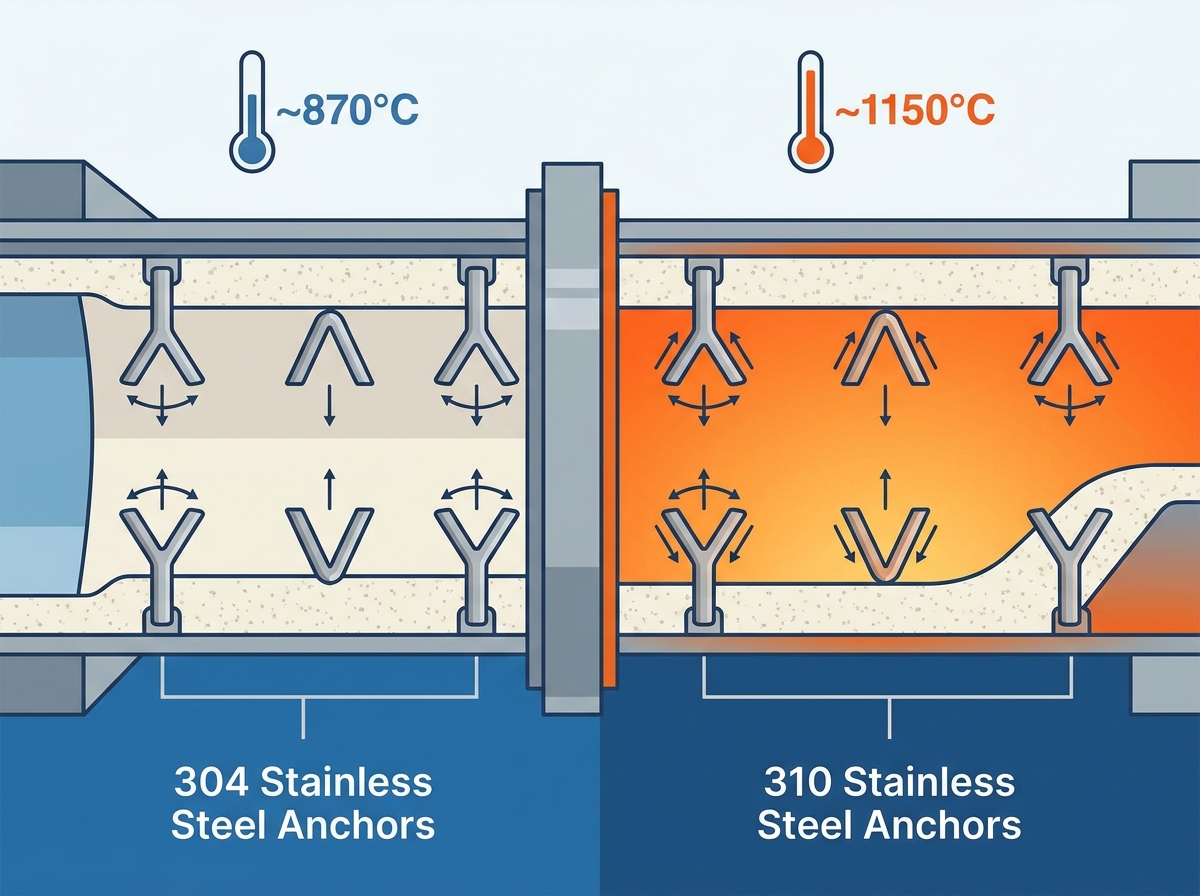
The fundamental difference lies in the chromium and nickel content. These alloying elements are responsible for providing corrosion and oxidation protection in aggressive furnace and boiler atmospheres. Grade 304S contains a standard level of chromium and nickel, making it highly versatile and suitable for a wide range of general industrial applications. It provides excellent resistance to atmospheric corrosion and many organic and inorganic chemicals. In the context of refractory anchors, 304S is typically utilized in areas where the maximum temperature does not exceed approximately 870°C. This makes it appropriate for cooler zones of a cement plant, certain sections of preheaters, or backup insulation layers where direct exposure to peak combustion temperatures is mitigated.
Conversely, grade 310S is specifically engineered for high-temperature service. It boasts a significantly higher chromium and nickel content compared to 304S. This elevated alloy chemistry imparts superior resistance to oxidation and high-temperature corrosion. The high chromium content promotes the formation of a tenacious, protective oxide scale on the surface of the metal, which resists spalling even under cyclic heating and cooling conditions. As a result, 310S can withstand maximum temperatures of approximately 1150°C. This makes it the preferred choice for hotter zones in rotary kilns, combustion chambers, and areas directly exposed to radiant heat or aggressive flue gases.
In addition to 304S and 310S, advanced alloys like 253MA are also utilized for even more extreme environments. Grade 253MA incorporates rare earth elements and nitrogen to enhance high-temperature strength and oxidation resistance, allowing it to operate at maximum temperatures of approximately 1200°C. Understanding the temperature profile of the specific application is the first step in selecting the correct material grade to ensure the structural integrity of the refractory lining.
Beyond the material composition, the physical design of the refractory anchor plays a crucial role in its performance. The Y V Shaped 304S 310S 253MA Stainless Steel Anchor for Refractory Lining features a specific structural design that improves tensile strength and load distribution. When refractory castables are installed, they cure and harden around the anchors. During operation, the refractory material and the steel shell expand and contract at different rates due to their distinct coefficients of thermal expansion.
The Y and V shapes are engineered to absorb this thermal expansion stress effectively. The angled tines of the Y or V configuration provide a mechanical interlock with the refractory material, ensuring that the lining remains securely anchored even as it undergoes dimensional changes. This design distributes the load more evenly across the anchor and the surrounding refractory, reducing localized stress concentrations that could lead to cracking or spalling of the lining. By accommodating movement and maintaining a strong grip, these shaped anchors significantly extend the service life of the refractory installation.
For plant operators looking to upgrade their lining systems, sourcing high-quality 304S 310S Refractory Anchors is a critical step in preventive maintenance. The combination of the right material grade and an optimized structural shape ensures that the anchors can withstand the rigorous demands of continuous industrial operation.
Industrial furnaces and kilns come in a vast array of designs, sizes, and operational parameters. Therefore, refractory anchors cannot be a one-size-fits-all solution. Manufacturers provide a range of specifications and customization options to meet the unique requirements of different installations.
The available material grades—304S, 310S, and 253MA—cover a broad spectrum of temperature requirements, from ~870°C up to ~1200°C. However, the customization extends beyond just the alloy. The size range is highly adaptable, with custom sizes available, including custom lengths, diameters, and anchor shapes. The length of the anchor must be carefully calibrated to the thickness of the refractory lining; it must be long enough to provide sufficient holding power but short enough to remain safely embedded beneath the hot face of the refractory, protecting the tip of the anchor from direct exposure to the maximum furnace temperature.
The diameter of the wire or rod used to form the anchor dictates its mechanical strength and load-bearing capacity. Heavier, thicker linings require anchors with larger diameters to support the increased weight and resist the higher shear forces generated during thermal cycling.
Furthermore, surface finish options are available to suit different application needs. These include Natural, Polished, or Passivated finishes. A passivated finish, for example, involves treating the stainless steel with a mild oxidant to remove free iron from the surface and enhance the protective chromium oxide layer, further improving corrosion resistance before the anchor is even installed.
The performance of even the highest quality refractory anchor is heavily dependent on proper installation techniques. Incorrect installation can lead to premature failure of the anchor and, consequently, the collapse of the refractory lining. A meticulous approach to installation and maintenance is required.
The first critical step is to determine the anchor spacing based on the furnace structure and the lining thickness. This calculation must also consider the operating temperature and the anticipated thermal expansion of both the refractory material and the steel shell. Anchors placed too far apart will not provide adequate support, leading to bulging or slumping of the lining. Anchors placed too closely together can create excessive stress points and interfere with the proper flow and compaction of refractory castables during installation.
Selecting a fixing or welding method suitable for the service temperature is equally important. The weld must be strong enough to hold the anchor securely to the shell under all operating conditions. The welding consumable must be compatible with both the shell material (typically carbon steel) and the anchor material (stainless steel) to prevent galvanic corrosion or brittle weld joints. The welding or fixing method must strictly match the furnace design and the operating temperature.
During installation, technicians must maintain the correct embedment depth and ensure proper anchor orientation to avoid stress concentration. The tines of the Y or V shaped anchors should be oriented to provide maximum resistance against the primary forces acting on the lining, whether those are gravitational forces in a vertical wall or shear forces in a rotating kiln.
Crucially, installers must leave sufficient movement space for high-temperature expansion to prevent cracking or spalling. Some installation techniques involve applying a combustible coating or wrapping the anchor tips with plastic caps that burn away during the initial heat-up, leaving a small void that allows the metal anchor to expand without exerting undue pressure on the surrounding rigid refractory.
Finally, before any refractory casting or lining installation begins, it is mandatory to verify the anchor positioning and fixing strength. A thorough inspection ensures that all anchors are securely attached, properly spaced, and correctly oriented, laying the foundation for a durable and reliable refractory lining.
While cement kilns in Mexico and worldwide represent a major application, the utility of these stainless steel refractory anchors extends across a wide variety of heavy industries that rely on high-temperature processing.
In the power generation sector, these anchors are essential for supporting refractory linings in power plant boiler flues, combustion chambers, and superheaters. These environments expose the linings to high temperatures, abrasive ash particles, and corrosive combustion gases. The high chromium and nickel content of the anchors provides the necessary protection to maintain structural integrity.
The metallurgical industry relies heavily on robust refractory systems. These anchors are used for securing heavy-duty refractory linings in steel industry preheaters, blast furnaces, and various smelting operations. The extreme heat and aggressive chemical nature of molten metals and slags require anchors that can endure severe conditions without degrading.
In the chemical and petrochemical sectors, anchors are deployed for anchoring refractory linings in thermal processing reactors, heat exchangers, and incinerators. These applications often involve complex chemical reactions, high pressures, and corrosive byproducts, necessitating the use of high-grade alloys like 310S or 253MA.
Furthermore, they are used for holding high-temperature refractory materials in glass and ceramic kilns, where precise temperature control and clean environments are required to produce high-quality products. They are also widely used for stabilizing refractory lining in rotary kilns across various mineral processing applications beyond cement, such as lime calcination or alumina production. In all these scenarios, the anchors are compatible with various refractory castables and bricks, providing a versatile solution for fixing castables and refractory bricks in industrial furnaces of all types.
When procuring materials for critical infrastructure like industrial kilns and furnaces, quality assurance is paramount. The failure of a single anchor can initiate a chain reaction leading to extensive lining damage, forcing an unscheduled shutdown that can cost a facility hundreds of thousands of dollars in lost production and repair costs.
To ensure reliability, material certificates and quality inspection reports are provided by the manufacturer. These documents verify the chemical composition of the steel, ensuring that the specified grade (whether 304S, 310S, or 253MA) has been supplied and that it meets the required metallurgical standards. They also confirm that the physical dimensions and structural integrity of the anchors meet the specified tolerances.
It is important to remember the inherent limitations and conditions associated with these products. The temperature resistance depends strictly on the specific material grade chosen. Utilizing a 304S anchor in an environment that exceeds ~870°C will lead to rapid oxidation, loss of strength, and eventual failure. Therefore, accurate thermal mapping of the furnace or kiln is a prerequisite for proper material selection.
The Y V Shaped 304S 310S 253MA Stainless Steel Anchor for Refractory Lining represents a highly engineered, reliable solution for securing critical high-temperature linings across diverse industrial applications, offering exceptional structural design that improves tensile strength and load distribution while absorbing thermal expansion stress, combined with high chromium and nickel content for superior corrosion and oxidation protection up to ~1200°C depending on the selected grade, making it an indispensable component for facility managers and refractory engineers focused on maximizing the operational uptime and safety of cement kilns, power plant boilers, and petrochemical reactors.