Views: 0 Author: Site Editor Publish Time: 2026-06-29 Origin: Site
The industrial landscape in Mexico relies heavily on high-temperature processing facilities, where the structural integrity of thermal processing equipment is paramount for continuous, efficient, and safe operations. Within these demanding environments, the selection of internal support components dictates the longevity and reliability of the entire thermal enclosure. Among the most critical components in this infrastructure are Stainless Steel Refractory Anchors, which serve as the foundational skeleton holding protective linings in place. When operating industrial furnaces, boilers, and kilns, the internal temperatures and harsh atmospheric conditions require materials that can withstand extreme thermal stress without compromising their mechanical grip on the surrounding refractory materials. The integration of high-quality anchoring systems is not merely a structural preference but a fundamental requirement for maintaining the operational viability of heavy industrial applications across various sectors, including cement production, petrochemical refining, metal smelting, and power generation.
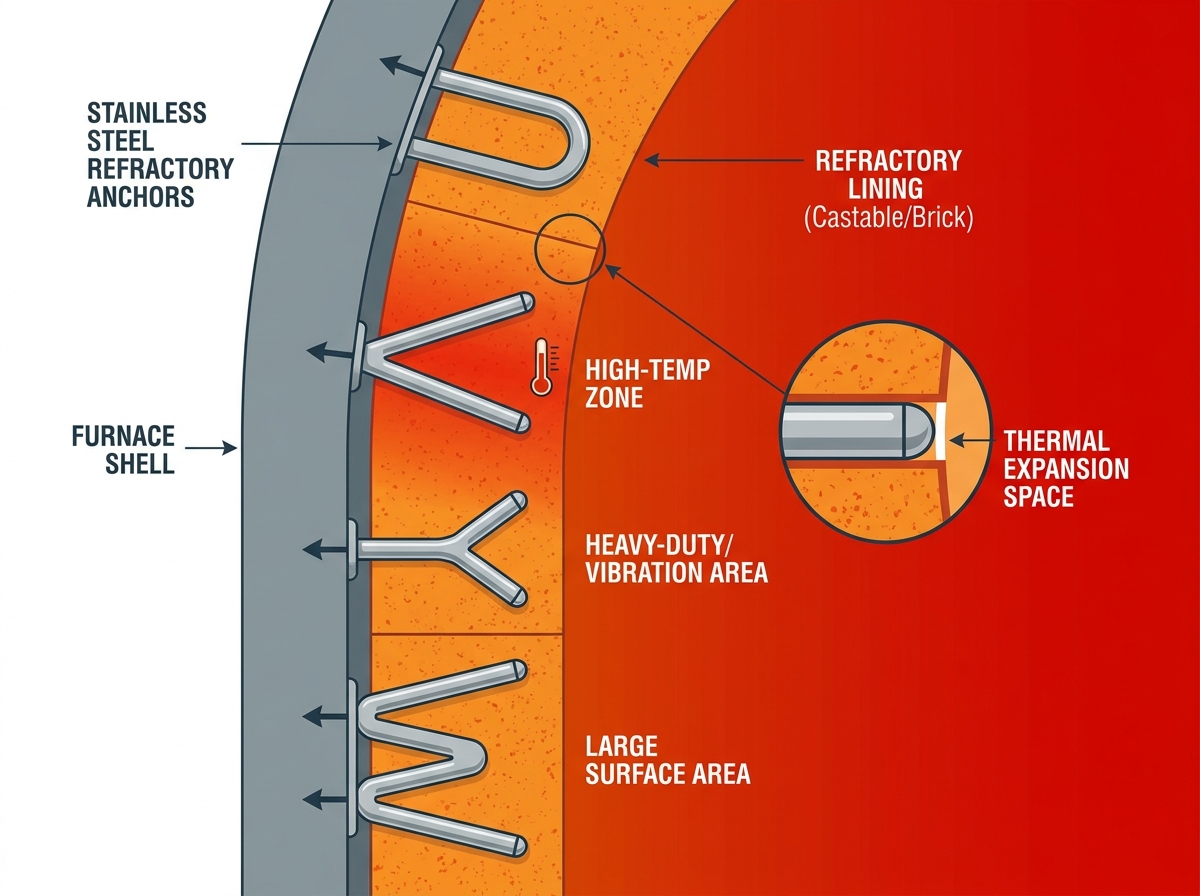
High-quality stainless steel refractory anchoring systems designed to secure protective linings in high-temperature industrial furnaces.
To fully appreciate the necessity of these components, one must understand the dynamic forces at play within an industrial furnace. The refractory lining, which acts as a thermal barrier protecting the outer steel shell of the furnace from melting or degrading, is subjected to intense heat, chemical attack, and mechanical abrasion. However, refractory materials, whether they are castables, bricks, or monolithic refractory materials, possess significant weight and are susceptible to shifting, cracking, and structural failure if not properly secured. This is where the anchoring system becomes indispensable. By embedding a specialized Stainless Steel Refractory Anchor into the furnace shell and extending it into the refractory material, engineers create a composite structure that can endure the rigors of industrial processing. The anchors hold the refractory lining tight against the furnace wall, preventing it from collapsing inward under its own weight or detaching due to the intense vibrations and thermal cycling characteristic of heavy industrial operations.
The primary function of Stainless Steel Refractory Anchors is to secure refractory linings in industrial furnaces, boilers, and kilns. These environments are unforgiving, often operating continuously for months or years at a time. The anchoring system must bridge the gap between the relatively cool outer steel casing of the furnace and the extremely hot internal environment. Because the outer shell and the internal refractory lining expand and contract at different rates when exposed to heat, the anchoring system must be designed to accommodate this differential movement. If the anchors are too rigid or improperly designed, the resulting mechanical stress will cause the refractory material to fracture, leading to a phenomenon known as spalling, where chunks of the lining fall away, exposing the vulnerable steel shell to catastrophic heat damage.
The Leader Steel 304 310 Stainless Steel U Waved V Y Type Refractory Support Anchor for Furnace Lining is specifically engineered to address these complex structural challenges. As a premier example of Refractory Support Anchors, this product line offers a comprehensive solution for securing various types of refractory materials. The compatibility of these anchors extends across a wide range of lining types, including castables, traditional refractory bricks, and advanced monolithic refractory materials. This broad compatibility ensures that facility operators and refractory engineers can utilize a standardized, high-quality anchoring solution regardless of the specific refractory medium chosen for a particular thermal zone within their facility.
Furthermore, the design and manufacturing of these anchors take into account the diverse physical demands placed on different areas of a furnace or kiln. Not all zones within a thermal processing unit experience the same conditions. The roof of a furnace, for instance, requires anchors that can support the entire suspended weight of the refractory lining against the force of gravity. The sidewalls require anchors that can resist both vertical shear forces and horizontal expansion forces. Rotary kilns introduce the additional complexity of constant rotational movement and high vibration, necessitating an anchoring system that can withstand continuous dynamic loading. By offering a variety of shapes, sizes, and materials, these anchoring systems provide the necessary versatility to construct a robust and durable refractory lining tailored to the specific operational profile of the equipment.
The performance of Stainless Steel Refractory Anchors is fundamentally dictated by the metallurgical composition of the steel used in their construction. Because industrial furnaces operate at vastly different temperatures depending on their purpose, no single material is suitable for all applications. The maximum operating temperature of an anchoring system depends entirely on the chosen material, with capabilities ranging from 450°C for lower-temperature applications up to 1200°C for the most extreme environments. To accommodate this wide spectrum of thermal requirements, these refractory support anchors are available in an extensive array of materials, including 304, 310S, 321, 2520, 1Cr18Ni9Ti, Q235B, 20# Steel, 45# Steel, 15CrMo, and 12Cr1MoV.
Understanding the specific temperature thresholds of these materials is crucial for proper anchor selection. For mid-range temperature zones, 304 Stainless Steel is frequently utilized. The maximum operating temperature for 304 Stainless Steel in these applications is 870°C (1600°F). This makes it an excellent choice for areas of the furnace that do not experience the absolute peak temperatures of the combustion zone but still require the inherent corrosion resistance and structural stability that stainless steel provides over standard carbon steels.
For higher temperature zones, engineers must step up to more heat-resistant alloys. The 310S Stainless Steel variant is specifically alloyed to withstand significantly higher thermal loads, offering a maximum operating temperature of 1150°C (2100°F). The increased chromium and nickel content in 310S provides superior resistance to oxidation at these elevated temperatures, ensuring that the anchor does not rapidly degrade and lose its structural integrity when exposed to the harsh internal atmosphere of the furnace.
In the most extreme thermal environments, such as the direct combustion zones of high-output kilns and specialized smelting furnaces, even 310S may not be sufficient. For these critical applications, 2520 Stainless Steel is available, boasting a maximum operating temperature of 1200°C (2200°F). This exceptional heat resistance ensures that the anchoring system remains viable and continues to hold the refractory lining securely in place even when subjected to the most punishing thermal conditions found in modern industrial processing.
Material Grade | Maximum Operating Temperature (°C) | Maximum Operating Temperature (°F) |
|---|---|---|
304 Stainless Steel | 870°C | 1600°F |
310S Stainless Steel | 1150°C | 2100°F |
2520 Stainless Steel | 1200°C | 2200°F |
Beyond material composition, the physical geometry of the anchor plays a decisive role in its ability to secure the refractory lining effectively. The Leader Steel refractory support anchors are available in U, W, V, and Y shapes to support various lining thicknesses and load directions. Each shape is meticulously designed to optimize the holding power and stress distribution within specific types of refractory installations and operational environments.
The V-Type anchors are characterized by their simple yet highly effective divergent prong design. These anchors are specifically designed for high-temperature zones above 800°C. The V-shape allows for excellent penetration and gripping power within castable and monolithic refractory materials. As the refractory material cures and hardens around the divergent prongs, it creates a strong mechanical interlock that resists pull-out forces. The V-Type material thickness range spans from 8-16mm in diameter, providing a robust cross-sectional area that can withstand significant thermal and mechanical stress without bending or yielding under the weight of the lining.
Industrial applications that involve continuous movement, such as rotary kilns used in cement production, subject the refractory lining to intense dynamic forces. For these demanding scenarios, Y-Type anchors are the optimal choice. Y-Type anchors are suited for heavy-duty applications, rotary kilns, and high vibration areas. The distinct Y-shape provides a superior multi-directional grip within the refractory material, distributing the stress of vibration and rotational gravity over a wider area. This prevents the refractory from vibrating loose and cracking around the anchor points. To accommodate the extreme mechanical loads present in these environments, the Y-Type material thickness range is substantial, measuring between 10-20mm in diameter, making them the most heavy-duty option in the product lineup.
Furnaces that undergo frequent heating and cooling cycles face a unique set of challenges. Thermal cycling causes the refractory lining and the steel shell to repeatedly expand and contract, creating immense internal stresses that can quickly tear a lining apart. W-Type anchors are intended for large surface areas and thermal cycling environments. The undulating, wave-like design of the W-Type anchor provides multiple points of contact and interlocking within the refractory material, while also offering a degree of geometric flexibility that helps absorb and dissipate the stresses associated with thermal expansion and contraction. The W-Type material thickness range is available from 6-14mm in diameter, allowing for precise matching of the anchor's strength to the specific requirements of the thermal cycling environment.
The U-Type anchor provides a classic, highly reliable anchoring solution for a wide variety of standard furnace and boiler applications. The U-shape creates a solid loop of support that is particularly effective when used in conjunction with anchoring rods or when securing specific types of refractory brickwork and layered castable linings. The U-Type material thickness range is offered between 6-12mm in diameter, providing a versatile and dependable option for general-purpose refractory support where the extreme specialized features of the V, Y, or W types may not be strictly necessary.
The environment inside an industrial furnace is not only hot but often highly corrosive. Chemical byproducts from combustion, fluxing agents, and the raw materials being processed can attack the steel anchors, leading to premature failure even if the temperature limits are not exceeded. To combat this, the surface condition of the anchor is a critical factor in its overall longevity. These refractory support anchors are offered with natural, polished, or passivated surface finishes to enhance corrosion resistance. A passivated finish, in particular, chemically treats the surface of the stainless steel to maximize its natural passive oxide layer, significantly improving its ability to resist chemical attack and oxidation in harsh atmospheric conditions.
Recognizing that industrial furnaces and kilns come in an infinite variety of designs, sizes, and configurations, a one-size-fits-all approach to refractory anchoring is rarely sufficient. Facility operators frequently encounter unique structural challenges that require specialized anchoring solutions. To meet these exact requirements, custom manufacturing is available for specific lengths, diameters, shapes, and surface treatments. This custom capability ensures that engineers are not forced to compromise their lining design by using off-the-shelf anchors that do not perfectly match the required lining thickness, load direction, or environmental conditions of their specific thermal processing equipment.
The highest quality anchoring system will fail if it is not installed correctly. The installation of refractory anchors is a precision engineering task that requires careful planning and execution. One of the most critical aspects of installation is determining the correct layout and density of the anchors across the furnace shell. Anchor spacing and depth must be determined based on lining thickness and operating temperature. If the anchors are spaced too far apart, the refractory material between them will lack sufficient support and may bulge or collapse. If they are placed too close together, it can create planes of weakness within the refractory lining and unnecessarily increase the cost and complexity of the installation. Furthermore, the depth to which the anchor penetrates the refractory material must be carefully calculated to ensure it provides adequate grip without extending too close to the hot face, where it could be exposed to temperatures exceeding its metallurgical limits.
Another paramount consideration during installation is the management of thermal expansion. As the furnace heats up, both the steel shell and the refractory lining will expand, but they will do so at different rates. The installation requires leaving room for thermal expansion to prevent cracking or spalling. If the anchors are welded rigidly and the refractory is cast tightly around them without any provision for movement, the resulting stress will inevitably fracture the lining. Techniques such as applying combustible caps or tape to the tips of the anchors before casting the refractory are often employed. When the furnace is fired for the first time, these materials burn away, leaving a small void that allows the anchor to expand safely without exerting destructive force on the surrounding refractory material.
Prior to the actual installation of the castable, brick, or monolithic refractory, a rigorous quality control check must be performed on the anchoring system itself. Positioning and stability must be verified prior to refractory installation. Every single anchor must be inspected to ensure it is securely welded to the furnace shell, oriented in the correct direction to handle the anticipated load, and positioned at the precise depth specified by the engineering design. Any loose, misaligned, or improperly welded anchors must be corrected before the refractory is applied, as fixing an anchoring issue after the lining has been installed is incredibly difficult, time-consuming, and expensive.
When dealing with critical infrastructure components like refractory anchors, traceability and quality assurance are non-negotiable. Facility operators and maintenance engineers must have absolute confidence that the materials they are installing meet the exact specifications required for their high-temperature applications. To guarantee this level of quality and provide peace of mind, material certificates and inspection reports are available upon request. These documents provide verified proof of the metallurgical composition, physical dimensions, and manufacturing quality of the anchors, ensuring compliance with stringent industrial standards and safety regulations.
Furthermore, selecting the correct anchor shape, material, and layout can be a complex engineering challenge, particularly for unique or highly demanding thermal processing applications. To assist facility operators and contractors in making the best possible decisions for their specific needs, engineering support is provided for anchor selection. This expert guidance ensures that the chosen anchoring system is perfectly matched to the operating temperature, refractory type, mechanical loads, and chemical environment of the furnace, ultimately maximizing the lifespan and reliability of the refractory lining.
In conclusion, the structural integrity of industrial furnaces, boilers, and kilns relies entirely on the quality and appropriate selection of their internal anchoring systems. These refractory support anchors, available in highly durable 304, 310S, and 2520 stainless steel alloys, as well as various carbon and specialized steel grades, provide the essential mechanical grip required to hold castables, bricks, and monolithic linings securely in place. With versatile U, W, V, and Y shapes designed to handle everything from standard thermal zones to high-vibration rotary kilns and intense thermal cycling environments, alongside custom manufacturing capabilities and comprehensive engineering support, these anchoring systems deliver exceptional practical value and operational reliability for heavy industrial facilities demanding uncompromising performance from their high-temperature processing equipment.