Views: 0 Author: Site Editor Publish Time: 2026-06-29 Origin: Site
In the demanding landscape of heavy industry, the structural integrity of high-temperature equipment relies heavily on the foundational components that secure protective linings against extreme operational stresses. Among these critical hardware components, Y Type Refractory Anchors stand out as essential engineering solutions designed to maintain the stability, durability, and longevity of thermal processing units. Whether operating within the continuous rotation of a cement plant or the intense thermal environment of a steel plant, the reliability of the refractory lining is directly tied to the quality and specification of its anchoring system. Manufactured by Leader Steel, these specialized anchors are categorized as a premium Refractory Anchor / Furnace Anchor solution, engineered to meet the rigorous demands of modern industrial applications. By providing a secure framework for castable materials, these anchors prevent catastrophic lining failures, ensure optimal thermal efficiency, and minimize the need for unscheduled maintenance interventions across various sectors.
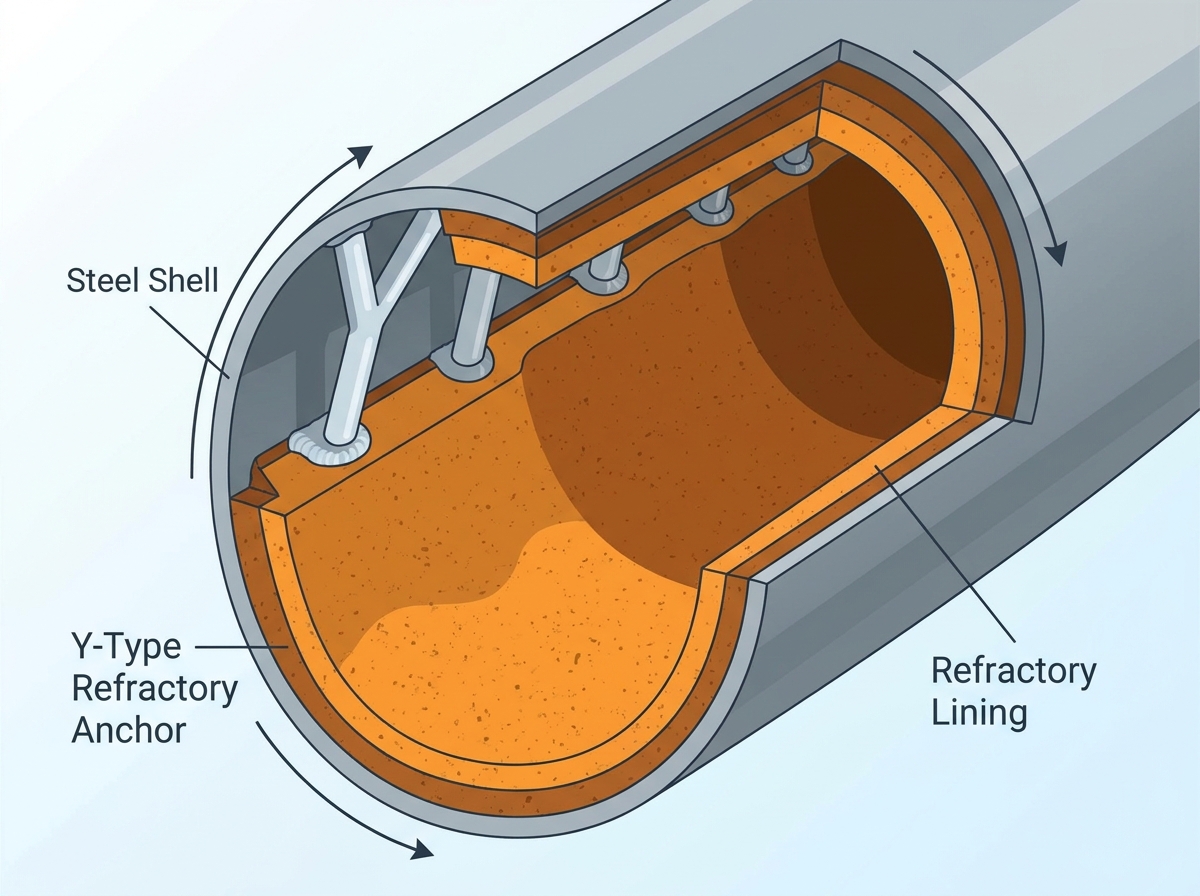
Custom fabricated Y Type Refractory Anchors engineered to provide central holding support for thick refractory linings in high-temperature industrial equipment.
The primary function of a Y Type Refractory Anchor is securing refractory linings and castables within high-temperature vessels. Without a properly designed and installed anchoring system, the refractory material would be susceptible to detachment, cracking, and eventual collapse under its own weight or due to the extreme thermal and mechanical stresses present in industrial environments. Constructed from high-quality, heat-resistant metal, these anchors are specifically designed to hold refractory lining systems securely in high-temperature equipment. The selection, customization, and installation of these components require a deep understanding of the specific operational conditions of the equipment, including the operating temperature, the chemical composition of the process atmosphere, and the physical demands placed on the lining during normal operation, startup, and shutdown phases.
The geometric design of an anchoring system plays a pivotal role in its ability to retain refractory materials effectively. The defining characteristic of this specific product is its shape: a highly efficient Y Shape. This specific configuration is not merely an aesthetic choice but a deeply functional engineering design. The product features a Y-type geometry that provides central holding support for thicker castable constructions. When dealing with thick refractory linings, the weight and volume of the castable material require an anchor that can distribute holding forces evenly throughout the depth of the lining. The diverging legs of the Y shape extend outward into the castable, creating a robust mechanical bond that resists pull-out forces and prevents the refractory from separating from the steel casing.
This central holding support is particularly crucial in applications where the refractory lining is subjected to gravity, vibration, or mechanical impact. By anchoring the core of the castable mass, the Y-type geometry ensures that the entire thickness of the lining acts as a cohesive unit. This unified structure is far more resilient to thermal shock and mechanical stress than a lining that is only superficially attached to the vessel wall. Furthermore, the Y shape allows the castable material to flow easily around the anchor during the installation process, ensuring complete encapsulation and minimizing the formation of voids or weak points within the refractory matrix. This seamless integration between the anchor and the castable is fundamental to achieving a durable and long-lasting refractory lining system.
When engineering a refractory lining for heavy-duty applications, the thickness of the castable is often increased to provide greater thermal insulation and extended wear life. However, thicker castables present unique challenges in terms of retention and stability. The mechanics of Y Type Refractory Anchors are specifically suited to address these challenges. The central holding support provided by the Y-type geometry ensures that the holding force is applied at the optimal depth within the lining, preventing the outer layers of the castable from spalling or shearing off. This deep-seated anchoring is essential for maintaining the structural integrity of the lining over extended periods of operation, particularly in environments characterized by rapid temperature fluctuations or abrasive process materials.
The performance and longevity of an anchoring system are intrinsically linked to the material from which it is constructed. Because application temperature is dependent on the selected material grade, choosing the correct alloy is the most critical decision in the specification process. Leader Steel offers these anchors in a comprehensive range of common materials, including SS 304, SS 310, SS 316, 321, 253MA, Inconel, and RA330. Each of these materials possesses unique metallurgical properties that make it suitable for specific operational environments. Understanding the capabilities and limitations of each grade is essential for preventing premature failure and ensuring the reliable operation of the high-temperature equipment.
For standard applications, 304 Stainless Steel is suitable for general high-temperature lining systems with moderate temperature and atmosphere. This grade provides a baseline level of heat and oxidation resistance, making it a cost-effective choice for environments where thermal and chemical stresses are not excessively severe. However, when the operational demands increase, an upgrade in material specification becomes necessary. In these instances, 310 / 310S Stainless Steel is preferred for higher temperature duty and better heat resistance. The increased chromium and nickel content in the 310 and 310S grades provides superior protection against oxidation and scaling at elevated temperatures, ensuring that the anchor retains its structural strength and mechanical properties even under intense thermal loads.
In industrial processes where chemical corrosion is a primary concern, standard heat-resistant alloys may degrade rapidly. For these specific environments, 316 Stainless Steel is useful where corrosion resistance is a consideration. The addition of molybdenum to the 316 grade significantly enhances its resistance to pitting and crevice corrosion, particularly in atmospheres containing sulfur or other aggressive chemical compounds. Alternatively, in applications where the equipment operates continuously at high temperatures and requires exceptional structural integrity, 321 Stainless Steel is selected for elevated-temperature applications requiring improved stability. The titanium stabilization in the 321 grade prevents carbide precipitation during prolonged exposure to high temperatures, thereby maintaining the alloy's ductility and resistance to intergranular corrosion.
While standard stainless steel grades are sufficient for many industrial applications, certain processes push the limits of metallurgical endurance. For the most extreme operational environments, advanced superalloys are required. The 253MA, RA330, and Inconel grades are used for severe service environments with demanding temperature, oxidation, or process conditions. These premium alloys are engineered to withstand the harshest industrial atmospheres, providing unparalleled resistance to high-temperature oxidation, carburization, and thermal fatigue. Utilizing these advanced materials ensures that the anchoring system remains intact and functional even when subjected to the most aggressive and unforgiving process conditions, thereby safeguarding the entire refractory lining from catastrophic failure.
Industrial equipment varies significantly in design, size, and operational parameters, meaning that a one-size-fits-all approach to refractory anchoring is rarely effective. Recognizing this, the manufacturing process for these components is highly adaptable. The anchors can be custom fabricated, allowing adjustments to length, leg spacing, wire diameter, tip style, and welding form. This extensive customization capability ensures that every anchoring system is perfectly tailored to the specific requirements of the vessel and the refractory lining. The length and diameter/thickness are customized to match the exact specifications dictated by the thermal engineering design, ensuring optimal embedment and load distribution within the castable.
The manufacturing method is equally versatile, with options including wire formed, welded, and fabricated to drawing. This flexibility allows for the production of anchors that meet precise geometric tolerances and structural requirements. Whether the application calls for a simple wire-formed anchor for a lightweight lining or a complex, heavily welded assembly for a massive rotary kiln, the fabrication process can be adapted to deliver the required component. Furthermore, the surface condition of the anchors can be tailored to the specific needs of the installation. The anchors can be supplied as fabricated, pickled, or cleaned on request. Proper surface preparation is crucial for ensuring a strong, defect-free weld when attaching the anchor to the steel shell, and options like pickling or specialized cleaning help remove surface contaminants and oxidation that could compromise the integrity of the weld joint.
The most precisely engineered and manufactured anchor will fail if it is not installed correctly. Proper installation protocols are paramount to the success of the refractory lining system. These anchors are installed by welding to a steel shell or structure. The quality of this weld is critical, as it forms the primary mechanical connection between the refractory lining and the supporting vessel. The welding process must be executed with precision, ensuring complete fusion and adequate strength to withstand the operational loads. Furthermore, the anchor height must be matched to lining depth and working zone. If the anchor is too short, it will not provide sufficient holding power for the outer layers of the castable; if it is too long, it may become exposed to the extreme temperatures of the working zone, leading to rapid oxidation and premature failure.
A critical aspect of the installation design is determining the appropriate density and distribution of the anchors across the steel shell. The system requires closer spacing for severe vibration, abrasion, cyclic temperature change, or physical abuse. In environments where the refractory lining is subjected to intense mechanical shocks or rapid thermal cycling, a higher density of anchors is necessary to distribute the stresses more evenly and prevent localized failures. The closer spacing ensures that no single anchor is overwhelmed by the operational forces, thereby maintaining the overall integrity of the lining. Conversely, wider spacing is permissible only where lining stress is lower and design allows. In static equipment with stable operating temperatures and minimal mechanical agitation, a less dense anchoring pattern may be sufficient, provided it aligns with the engineering specifications of the refractory design.
One of the most significant challenges in high-temperature industrial equipment is managing the dimensional changes that occur due to thermal fluctuations. As the equipment heats up and cools down, both the steel shell and the refractory lining will expand and contract, but they do so at different rates. Therefore, the installation must allow for refractory expansion and contraction. If the anchoring system is too rigid or improperly spaced, the differential thermal expansion can generate immense internal stresses, leading to severe cracking, spalling, or complete detachment of the refractory material. The design and placement of the anchors must accommodate these thermal movements, ensuring that the lining remains securely attached without being subjected to destructive compressive or tensile forces.
The robust design and versatile material options of these anchoring systems make them indispensable across a wide spectrum of heavy industrial sectors. They are extensively used in industrial furnaces, reheating furnaces, boilers, and boiler ducts. In industrial and reheating furnaces, the anchors secure the heavy castable linings that insulate the structural steel from the intense heat required for metal processing. In boilers and boiler ducts, they maintain the integrity of the refractory materials that protect the equipment from high-temperature combustion gases and abrasive particulate matter. The reliability of the anchoring system in these applications is essential for maintaining thermal efficiency, protecting the structural casing, and ensuring the continuous, uninterrupted operation of the facility.
Furthermore, these anchors are highly suitable for rotary kilns, petrochemical heaters, and incinerators. Rotary kilns present one of the most challenging environments for refractory linings due to the continuous rotation, which subjects the lining to constant mechanical stress, vibration, and the abrasive action of the tumbling process material. The central holding support provided by the Y-type geometry is crucial for preventing the heavy castable blocks from dislodging under these dynamic conditions. In petrochemical heaters and incinerators, the anchors must withstand not only high temperatures but also highly corrosive and oxidative atmospheres. The availability of advanced alloys like Inconel and 316 Stainless Steel ensures that the anchoring system can survive these harsh chemical environments without degrading.
The broad utility of these components is further demonstrated by their widespread application in cement plants, steel plants, power generation units, and heat treatment equipment. In cement plants, they secure the linings in the preheaters, kilns, and coolers. In steel plants, they are critical components in blast furnaces, ladles, and tundishes. Power generation units rely on them for boiler linings and ash handling systems, while heat treatment equipment utilizes them to maintain precise thermal environments for metallurgical processing. Across all these diverse applications, the fundamental requirement remains the same: a secure, reliable, and durable anchoring system capable of withstanding the specific thermal, mechanical, and chemical stresses of the process.
While these anchoring systems are engineered for maximum durability, their performance is strictly bound by the laws of metallurgy and mechanical engineering. It is imperative to recognize the limitations of the system to prevent catastrophic failures. The most fundamental limitation is that application temperature is dependent on the selected material grade. Exposing an anchor to temperatures beyond the operational limits of its specific alloy will result in rapid oxidation, loss of mechanical strength, and eventual structural collapse. Therefore, rigorous thermal analysis and accurate material specification are non-negotiable prerequisites for a successful installation.
Beyond material selection, the physical parameters of the installation are equally critical. Incorrect height, spacing, or material selection can result in weaker lining retention, uneven stress distribution, and earlier repair. If the anchors are spaced too far apart in a high-vibration environment, the excessive load on each individual anchor will lead to fatigue and failure, resulting in weaker lining retention. If the anchor height is improperly matched to the lining depth, it creates uneven stress distribution within the castable, promoting crack propagation and spalling. Ultimately, any deviation from the engineered specifications—whether in material grade, physical dimensions, or installation spacing—will inevitably lead to earlier repair cycles, increased maintenance costs, and unacceptable operational downtime. Strict adherence to the verified engineering guidelines is the only way to ensure the long-term viability of the refractory lining system.
Y Type Refractory Anchors manufactured by Leader Steel represent a highly engineered, customizable solution for securing heavy refractory linings in demanding industrial environments. By offering central holding support through their specialized geometry and providing extensive customization in dimensions, materials, and fabrication methods, these anchors deliver exceptional structural integrity for thick castable constructions. Their compatibility with a wide range of standard and advanced alloys ensures reliable performance across diverse applications, from the severe mechanical stresses of rotary kilns in cement plants to the corrosive atmospheres of petrochemical heaters. When correctly specified and installed according to precise spacing and height requirements, these anchors provide immense practical value by preventing premature lining failure, optimizing thermal efficiency, and significantly reducing maintenance downtime for operators of high-temperature industrial equipment.