Views: 0 Author: Site Editor Publish Time: 2026-08-25 Origin: Site
The 2026 industrial landscape across North America faces intense operational demands. Nearshoring and manufacturing expansions push cement kilns, petrochemical reactors, and industrial furnaces to run hotter and longer. In this environment, refractory lining failure represents a severe operational risk. Unplanned downtime, thermal inefficiency, and catastrophic lining collapses often stem from substandard or improperly specified anchoring systems. Selecting the right mechanical support requires rigorous evaluation of metallurgy, operating temperatures, and thermal cycling. A failing anchor shears under stress, pulling tons of refractory castable down. Plant engineers must approach anchor selection with exact engineering standards. This guide provides a technical framework for evaluating and sourcing refractory anchors Mexico. Applying these principles ensures maximum lining lifespan, sustained energy efficiency, and uncompromising operational safety.
Material Selection is Application-Specific: Upgrading to high-nickel alloys (e.g., Alloy 601) is only cost-effective when operating temperatures exceed 1100°C or in highly corrosive atmospheres; standard 304/310 stainless steel remains viable for lower-tier thermal zones.
Innovations Drive Longevity: The 2026 market is seeing a shift toward energy-efficient alloys and advanced surface coatings that extend anchor life in harsh reactor and kiln environments.
Design Dictates Performance: The choice between V-anchors, Y-anchors, and ceramic anchors must directly align with the refractory type (castable, plastic, or ceramic fiber) and the mechanical load of the furnace roof or wall.
Installation Quality Equals Anchor Viability: Even premium alloys fail prematurely without strict adherence to welding protocols, proper anchor spacing, and the use of expansion caps to accommodate thermal growth.
Localized Supply Chain Advantage: Sourcing refractory anchors in Mexico mitigates 2026 supply chain bottlenecks, reducing lead times for critical turnaround and maintenance schedules.
Table of Contents
North American heavy industry supply chains are shifting rapidly. The global refractories market continues to expand, driven by heavy infrastructure investments and industrial modernization. Within this broader sector, the specific refractory anchor market is projected to surpass $385 million in 2026. Increased cement, steel, and petrochemical production directly positions Mexico as a primary growth hub. Industrial facilities require reliable, localized procurement to sustain continuous operations. Relying on distant suppliers introduces unacceptable risks when kiln turnarounds demand immediate component availability.
Importing anchors from overseas often involves longer lead times, unpredictable shipping delays, and tariff volatility. Plant managers face severe operational bottlenecks if replacement anchors do not arrive before a scheduled shutdown. Partnering with regional manufacturers mitigates these supply chain risks. Localized production enables rapid custom fabrication. When a petrochemical reactor requires an emergency turnaround, regional suppliers engineer, fabricate, and deliver specialized anchors in a fraction of the time required for international freight.
We see three distinct advantages to localized procurement in 2026:
Rapid prototyping for custom anchor profiles during unplanned outages.
Direct oversight of metallurgical testing and quality assurance.
Elimination of trans-oceanic shipping delays for heavy steel components.
Compliance remains a non-negotiable factor in heavy industry. Regional manufacturers must adhere to stringent regulatory standards. ASTM and API specifications govern refractory anchor manufacturing, dictating material composition, tensile strength, and metallurgical integrity. Proper material certification ensures every anchor installed meets the exact thermal and mechanical requirements of the facility. Sourcing locally secures certified, compliant components with a highly responsive delivery schedule.
You must match anchor metallurgy to the specific thermal zones within your equipment. A cement kiln operates across multiple temperature gradients. The preheater tower experiences vastly different thermal loads compared to the burning zone. Installing a uniform alloy across all zones guarantees premature failure in high-heat areas and wasted capital in low-heat areas. Engineers map the thermal profile of the furnace and specify alloys that maintain structural integrity at peak localized temperatures.
Atmospheric conditions accelerate metal degradation. Oxidizing, reducing, and sulfur-rich atmospheres attack anchor metallurgy aggressively. In sulfur-rich environments, standard stainless steels suffer from rapid sulfidation, leading to structural embrittlement. Reducing atmospheres strip protective oxide layers from the metal surface, exposing the core to carburization. Understanding the specific chemical environment inside the reactor or kiln dictates the alloy selection.
Atmosphere Type | Chemical Threat | Impact on Standard Steel | Recommended Mitigation |
|---|---|---|---|
Oxidizing | Excess Oxygen | Surface scaling and material loss | High Chromium alloys (310 SS) |
Reducing | Carbon Monoxide / Hydrogen | Carburization and embrittlement | High Nickel alloys (Alloy 601) |
Sulfur-Rich | Hydrogen Sulfide | Rapid sulfidation and cracking | Specialized coatings or Alumina-forming alloys |
Refractory anchors bear immense mechanical loads. They hold heavy monolithic castables and brick linings against gravity. Roof and overhanging installations present the highest risk of catastrophic failure. Success metrics for these applications require calculating the exact pull-out strength and shear resistance of the anchor profile. The fastening system supports the dead weight of the refractory material while it cures, during initial heat-up, and throughout its entire operational campaign.
Rotary kilns introduce dynamic mechanical stress. The anchors withstand continuous rotational forces and the abrasive flow of raw materials. As the kiln turns, the refractory lining shifts slightly, transferring massive shear forces directly to the anchors. If the anchor design lacks sufficient rigidity or if the weld penetration is inadequate, the rotational stress snaps the anchor at the base. Structural integrity in these environments demands robust anchor profiles and flawless welding execution.
Industrial furnaces rarely operate at a constant temperature. Continuous heating and cooling cycles create severe thermal fatigue. The steel shell, the metallic anchor, and the refractory lining all possess different coefficients of thermal expansion. As the furnace heats up, the metal shell expands outward, the anchor elongates, and the refractory concrete expands at a much slower rate. This differential expansion creates massive internal shear stress.
A successful anchoring system accommodates this movement without shearing. If the anchor is too rigid or tightly bound by the castable, the thermal growth either cracks the refractory or snaps the anchor weld. Fatigue resistance requires specific design interventions, such as floating anchor clips or expansion caps, to absorb the dimensional changes safely. Managing thermal cycling dictates the long-term survival of the lining.
Standard austenitic stainless steels form the baseline for refractory anchoring. Grade 304 offers basic oxidation resistance up to approximately 800°C. Grade 316 provides improved corrosion resistance due to its molybdenum content, making it suitable for mildly aggressive chemical environments. Grade 310 stands as the workhorse for mid-range high-heat applications. With higher chromium and nickel content, 310 stainless steel resists oxidation and maintains structural strength at continuous operating temperatures up to roughly 1050°C.
These standard grades serve specific, lower-tier thermal zones effectively. We recommend them for backup insulation layers, lower-temperature furnace zones, and standard petrochemical applications. Using 310 stainless steel in the cooler sections of a cement kiln preheater tower provides excellent reliability. They offer a highly effective solution where thermal and atmospheric demands do not justify the investment in premium superalloys.
Extreme environments destroy standard stainless steels rapidly. High-performance alloys solve this problem through elevated nickel and chromium concentrations. Alloy 601 and Alloy 800 prevent severe embrittlement and resist catastrophic oxidation at extreme temperatures ranging from 1100°C to well over 1250°C. The high nickel content stabilizes the metallurgical structure, preventing the formation of brittle phases during prolonged exposure to intense heat.
These premium alloys are mandatory for the most punishing industrial zones. Specify high-nickel alloys for cement kiln burning zones, hazardous waste incinerators, and highly corrosive petrochemical reactors. In a hazardous waste incinerator, the combination of extreme heat and aggressive chemical byproducts dissolves standard 310 stainless steel in weeks. Alloy 601 provides the necessary resilience to maintain lining integrity throughout a full operational campaign.
The 2026 market introduces significant material innovations. Specialized oxidation-resistant coatings and energy-efficient alloy treatments enhance the durability of standard metals. These surface treatments create a sacrificial or highly stable barrier that protects the underlying steel from atmospheric attack. By altering the surface chemistry, manufacturers push the operational limits of standard alloys further than previously possible.
These innovations serve as a highly effective middle-ground solution. They extend campaign life in moderately corrosive environments without requiring the full investment of high-nickel upgrades. If a furnace zone operates slightly above the comfortable limit for 310 stainless steel, but does not reach the extreme thresholds requiring Alloy 601, a coated 310 anchor provides the perfect engineering compromise. This approach optimizes material performance while managing procurement budgets effectively.
Alloy Grade | Max Continuous Temp (°C) | Primary Application | Atmospheric Resistance |
|---|---|---|---|
304 Stainless Steel | ~800°C | Backup insulation, low-heat zones | Basic oxidation resistance |
310 Stainless Steel | ~1050°C | Preheater towers, standard furnaces | Good oxidation, moderate sulfidation |
Alloy 601 | ~1200°C+ | Burning zones, incinerators | Excellent oxidation and carburization resistance |
Ceramic Anchors | 1250°C - 1600°C | Forge furnaces, extreme-heat roofs | Immune to metallic corrosion |
When operating temperatures exceed the melting point of metallic alloys, engineers transition to refractory ceramic anchors. Metallic anchors lose their tensile strength rapidly above 1250°C, becoming pliable and eventually failing under the weight of the lining. Ceramic anchors, typically made from high-alumina compositions, withstand extreme thermal loads without softening or oxidizing.
Ceramic anchors are essential for forge furnaces, reheat furnaces, and extreme-heat roof systems. Installation requires specialized metallic attachment clips. The metallic clip is welded to the cool steel shell, and the ceramic anchor locks into the clip, extending deep into the high-heat zone. This hybrid approach keeps the vulnerable metal components safely behind the insulation layer while the ceramic face endures the extreme furnace temperatures.
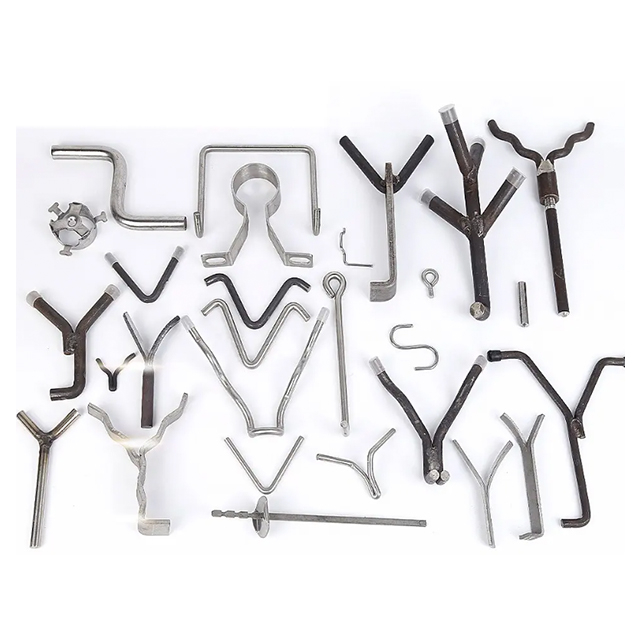
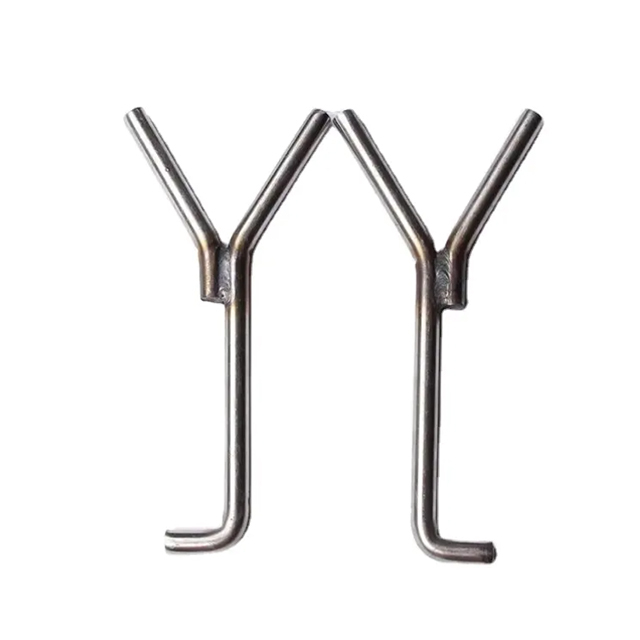
The geometric profile of an anchor determines its mechanical holding power. V-anchors and Y-anchors are the standard profiles for retaining dense monolithic castables. V-anchors provide a simple, effective spread that distributes the load across a wide area of the refractory concrete. Y-anchors offer a more complex geometry, providing enhanced grip and stability, particularly in thicker linings or high-vibration environments.
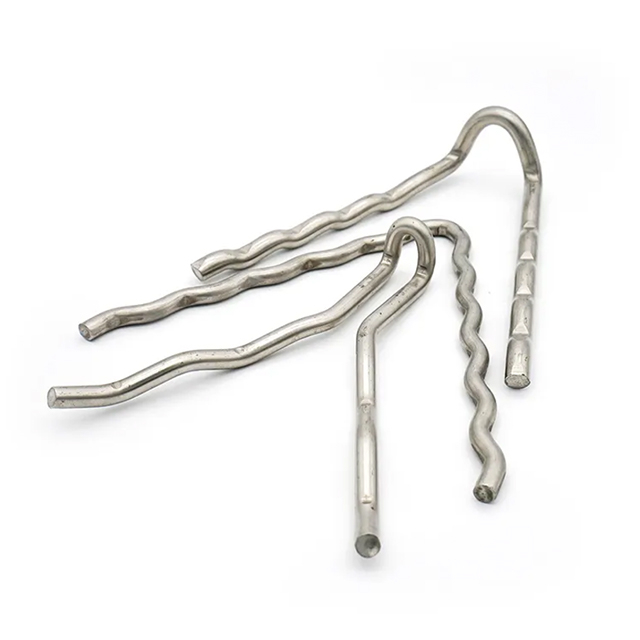
Corrugation drastically improves performance. Smooth wire anchors slip inside the castable as temperatures fluctuate. Corrugated tines increase the surface area of the anchor, creating a superior mechanical grip within the monolithic lining. The waves in the metal lock into the cured concrete, preventing the refractory from pulling away from the shell during thermal contraction. For heavy-duty applications, corrugated Y-anchors provide the highest level of structural security.
Ceramic fiber linings require completely different anchoring mechanics. Unlike dense concrete, ceramic fiber is lightweight and highly compressible. The anchoring system compresses the fiber blankets against the shell to prevent heat leakage and structural sagging. Threaded studs, speed clips, and cupped washers are designed specifically for this purpose.
The installation process involves welding the stud to the shell, impaling the ceramic fiber blanket over the stud, and locking it in place with a specialized clip or washer. The cupped washer compresses the fiber, creating a tight, thermally efficient seal. The design prevents the lightweight material from tearing or shifting under high-velocity airflows inside the furnace.
Fixed anchors are welded directly to the steel shell. They provide rigid, unyielding support. This rigidity works well for static environments but becomes a liability in systems with extreme thermal cycling. When the shell and the refractory expand at different rates, a fixed anchor absorbs the entire shear force. If the force exceeds the weld strength, the anchor breaks.
Floating anchors solve this problem. A floating system uses a holding clip welded to the shell. The anchor itself hooks into this clip, allowing for multi-directional movement. This design offers superior allowance for thermal expansion. As the furnace heats and materials shift, the floating anchor pivots slightly within its clip. This movement drastically reduces shear stress on the shell and prevents the refractory lining from cracking under thermal pressure.
The finest high-nickel alloy anchor fails instantly if the weld is defective. Poor weld penetration or the use of incorrect welding consumables leads to anchor detachment before the refractory even reaches operating temperature. When an anchor snaps at the base, it leaves a void in the support structure, transferring excessive load to the surrounding anchors and triggering a domino effect of lining collapse.
Mitigating this risk requires strict adherence to welding protocols. Facilities utilize certified welders trained in high-temperature alloy fabrication. You match the filler metal to the anchor metallurgy. For example, welding a 310 stainless steel anchor requires a 310 welding rod to ensure metallurgical compatibility.
Pre-weld surface preparation involves specific steps:
Grinding the steel casing to bare metal to remove rust and scale.
Wiping the weld zone with an approved industrial solvent to remove oils.
Ensuring the ambient temperature meets the minimum requirements for the specific alloy welding procedure.
Anchor spacing dictates the structural integrity of the entire lining. Insufficient anchor density causes the refractory to bulge and eventually collapse under its own weight. The span between supports becomes too great, allowing the concrete to flex and crack. Conversely, excessive anchor density creates continuous thermal bridges. Metal conducts heat faster than refractory concrete. Too many anchors transfer intense heat directly to the steel shell, causing shell warping and destroying the energy efficiency of the furnace.
Engineers calculate optimal anchor spacing based on specific variables. Lining thickness, material density, and installation orientation dictate the pattern. Roof installations require much tighter spacing to combat gravity. Standard industry guidelines provide a baseline, but complex kiln geometries require precise engineering calculations to balance mechanical support with thermal insulation efficiency.
Metal expands significantly faster and wider than refractory concrete when exposed to heat. If a metal anchor is cast rigidly inside dense concrete without any clearance, the expanding metal has nowhere to go. The force of the expanding steel easily cracks the surrounding castable, compromising the lining during the very first heat-up cycle.
Installing plastic or tape expansion caps on anchor tips is a strict requirement. These caps are placed over the tines of the anchor before the refractory is poured. During the initial curing and heat-up phase, the furnace temperature melts and burns off the plastic cap. This process leaves a perfectly sized void at the tip of the anchor. As the furnace reaches full operating temperature, the metal anchor expands safely into this void without exerting any cracking pressure on the surrounding refractory concrete.
Audit your upcoming maintenance schedules and review historical anchor failure rates to identify weak points in your current kilns.
Verify that your welding protocols and expansion cap installations meet strict engineering standards before the next shutdown.
Consult with a specialized manufacturer of refractory anchors Mexico to conduct material testing and review custom specifications.
Update your procurement guidelines to specify high-nickel alloys exclusively for zones exceeding 1100°C.
For industrial companies seeking dependable refractory solutions, Jiangsu Leader Special Steel Products Co., Ltd. provides professional high-temperature metal products and customized refractory anchor solutions for demanding industrial environments. With expertise in special steel manufacturing and application-focused solutions, the company helps customers improve furnace lining reliability, optimize material selection, and achieve safer long-term operation in high-temperature industries.
A: Nearshoring has drastically reduced lead times. Standard custom fabrication in Mexico typically ranges from two to four weeks, depending on alloy availability and design complexity. For emergency turnarounds, regional manufacturers expedite production, delivering critical components in a matter of days to prevent extended kiln downtime.
A: The choice depends strictly on temperature and atmosphere. Use 310 Stainless Steel for zones operating continuously below 1050°C with moderate atmospheres. Upgrade to Alloy 601 for burning zones exceeding 1100°C or environments with severe oxidation and carburization risks, as the higher nickel content prevents embrittlement.
A: Yes. Advanced oxidation-resistant coatings and specialized surface treatments are now available. These innovations improve the durability of standard alloys, providing a protective barrier against atmospheric attack. They offer a highly effective way to extend anchor lifespan in moderately corrosive environments without upgrading to expensive superalloys.
A: Metal expands faster than refractory concrete under high heat. Without clearance, expanding metal cracks the rigid concrete. Plastic expansion caps are placed on anchor tips before pouring. They burn off during initial heat-up, leaving a small void that allows the metal to expand safely without damaging the lining.
A: Anchor spacing depends on lining thickness, material density, and orientation. A general rule of thumb is spacing anchors two to three times the lining thickness. However, roof installations require much tighter density to combat gravity. Always rely on specific engineering calculations based on the exact mechanical load.
A: Metallic alloys lose critical tensile strength and begin to soften above 1200°C. For temperatures exceeding this threshold, you transition to refractory ceramic anchors. Ceramic anchors withstand extreme heat without deforming and are attached to the cooler steel shell using specialized metallic clips.
A: Monolithic castables require V-anchors or Y-anchors with corrugated tines to provide maximum mechanical grip inside the heavy concrete. Ceramic fiber linings are lightweight and require compression. They utilize threaded studs, speed clips, and cupped washers to pin and compress the fiber blankets tightly against the furnace shell.